Together, In Our Own Light
Robin Wall Kimmerer writes, “All flourishing is mutual.” I love this.
I’ve been writing a lot this year about dualities — how one truth often reveals its answering truth on the other side. The relationship between the individual and the collective is one of those tensions I keep circling. They’re not opposites to be resolved, but a relational duality — two forces that shape one another into a fuller whole.
The forest seems to model this effortlessly: nothing thrives alone. A tree becomes strong not by standing apart, but through the living web beneath it — the shared soil, the shared signals, the shared resilience that make survival possible.
And yet, a forest also shows us this: nothing grows in the same shape. Each tree negotiates its own design — some spiral, some lean, some rise in quiet conviction. They borrow light differently, cast their own shadows, endure their own storms. A forest is contradiction made beautiful: radical individuality woven through radical interdependence. It doesn’t just resolve the tension between the two; it thrives because of it. And so do we.
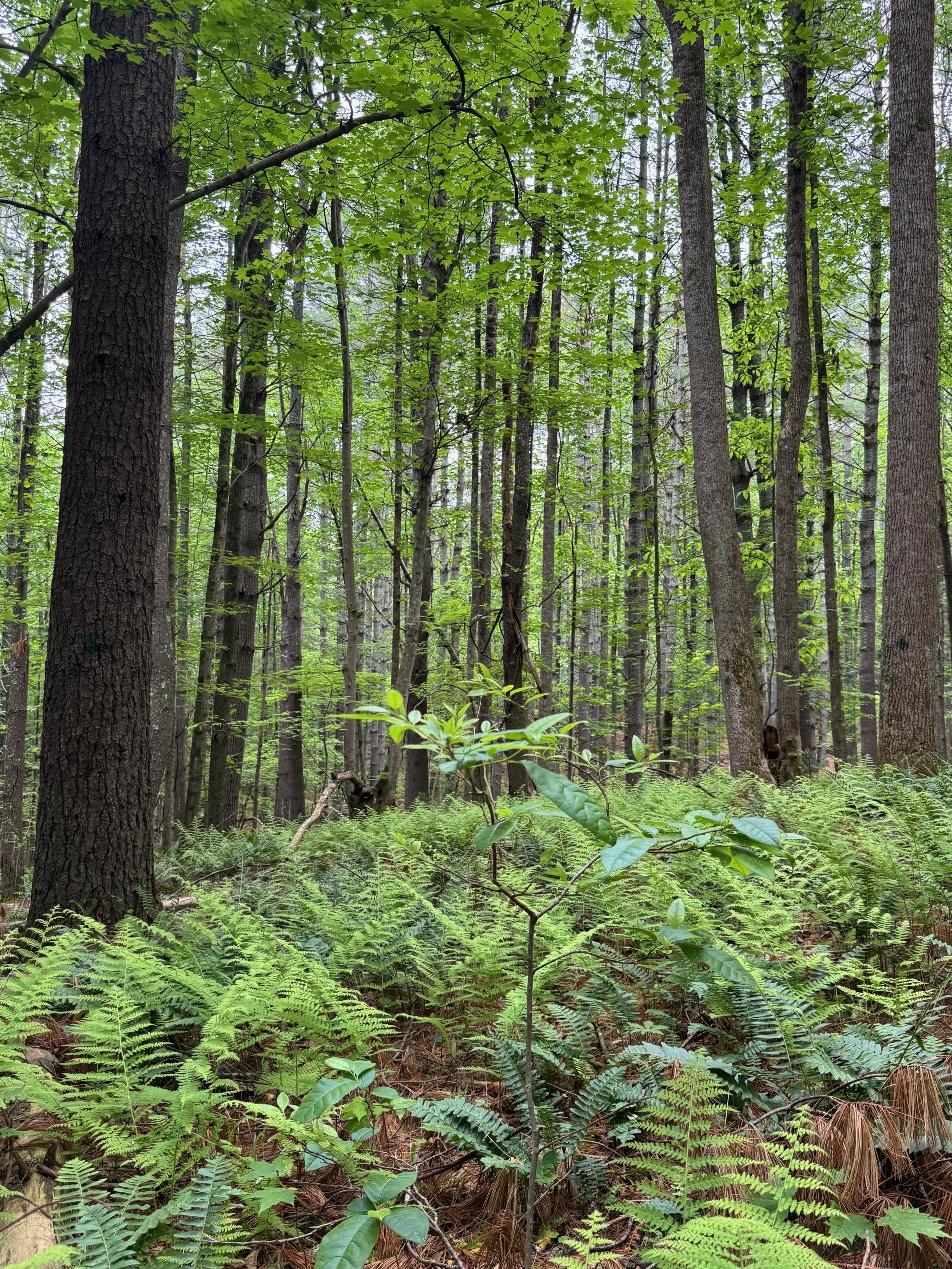
The Pine Forest at the NC Arboretum
Each tree still needs its own space, its own light, its own stretch of sky.
No two trees grow in the same way. Some lean. Some tower. Some widen. Some bloom late. Some break and return stronger. The individuality of each tree is not a violation of the forest — it is the forest.
Being an individual doesn’t pull us from the collective; it is part of how the collective breathes and grows.
This is a duality we often forget:
we are meant to be ourselves, fully and unmistakably,
and we are meant to belong to one another.
The Civil Rights Movement shows us some of this. Rosa Parks on a bus, John Lewis on a bridge, Fannie Lou Hamer at a microphone — each was a singular act of courage, a person standing firmly in their own light. Yet these moments became transformational because they were held by a collective: churches offering refuge, neighbors feeding marchers, students organizing across states, strangers linking arms.
Individual bravery made the movement possible,
and the movement made individual bravery effective.
A forest of distinct lives, rooted in shared purpose.
So the idea is not to choose between the self and the collective,
between the need for light and the need for connection.
Both belong. Both make us whole.
The forest stands not because the trees agree,
but because each tree grows into its own life
while the roots hold them in a shared ground.
And perhaps remembering this duality —
standing in our own light while honoring the roots we share —
is how we flourish.
So let us grow as the forest grows —
roots intertwined,
branches free,
each of us rising
in our own direction,
together,
in our own light.