The Modern Shed
On Slope, Simplicity, and the Spirit of Asheville’s New Vernacular
When I first moved to Asheville in 2006, the architectural conversation was rooted almost entirely in the past. The homes people admired most were the Arts and Crafts bungalows of Montford and Grove Park, the Art Deco landmarks downtown, and the lovingly preserved Victorian cottages scattered through older neighborhoods. Asheville had — and still has — a deep affection for its historic character. Preservation groups flourished, and the city’s architectural identity seemed defined by the craftsmanship of the early 20th century.
At that time, modernism was hiding in plain sight — tucked into hillsides, camouflaged among the trees, or quietly integrated into mid-century neighborhoods like Lakeview Park and Town Mountain. Few talked about these homes, and fewer still celebrated them. That gap — between Asheville’s celebrated past and its overlooked modernist thread — is what inspired me to start writing about and photographing modern architecture here. I wanted to uncover the stories of these homes and the people who designed them, to show that Asheville’s creativity didn’t stop with the Arts and Crafts era — it was still evolving.
Roots in the Land: The Original Shed Vernacular
Long before “modern mountain” appeared on builders’ websites, the region had its own pragmatic building language — one born from necessity rather than style. The old sheds, barns, and apple houses of Western North Carolina were defined by:
Craftsmanship: Simple but sturdy construction, often using hand-hewn timbers, exposed dovetail joints, and rough-sawn lapped siding.
Adaptation to terrain: Builders worked with the land, not against it. Bank barns and outbuildings were built into slopes, taking advantage of natural insulation.
Simplicity and function: Windows were few, porches modest, and every element served a purpose. Beauty came from proportion and weathering, not ornament.
These humble, handmade structures became the unintentional ancestors of Asheville’s latest design wave — the Modern Shed.
A Response to the Land
By the late 2000s and early 2010s, Asheville began to change. The city’s creative reputation drew new residents, infill lots became scarce, and the only land left was often steep, narrow, or oddly shaped. Builders had to adapt — and in doing so, they created a new kind of home that both respected and reinterpreted mountain pragmatism.
A typical example climbs in three tiers:
Lower level: Anchored to the slope — poured concrete or piers — serving as parking, storage, or workshop space.
Middle level: The living core — glass walls, decks, and open spaces that connect daily life to view and weather.
Top level: Private spaces — bedrooms or studios — tucked beneath a single shed-style roof angled to catch light and shed rain.
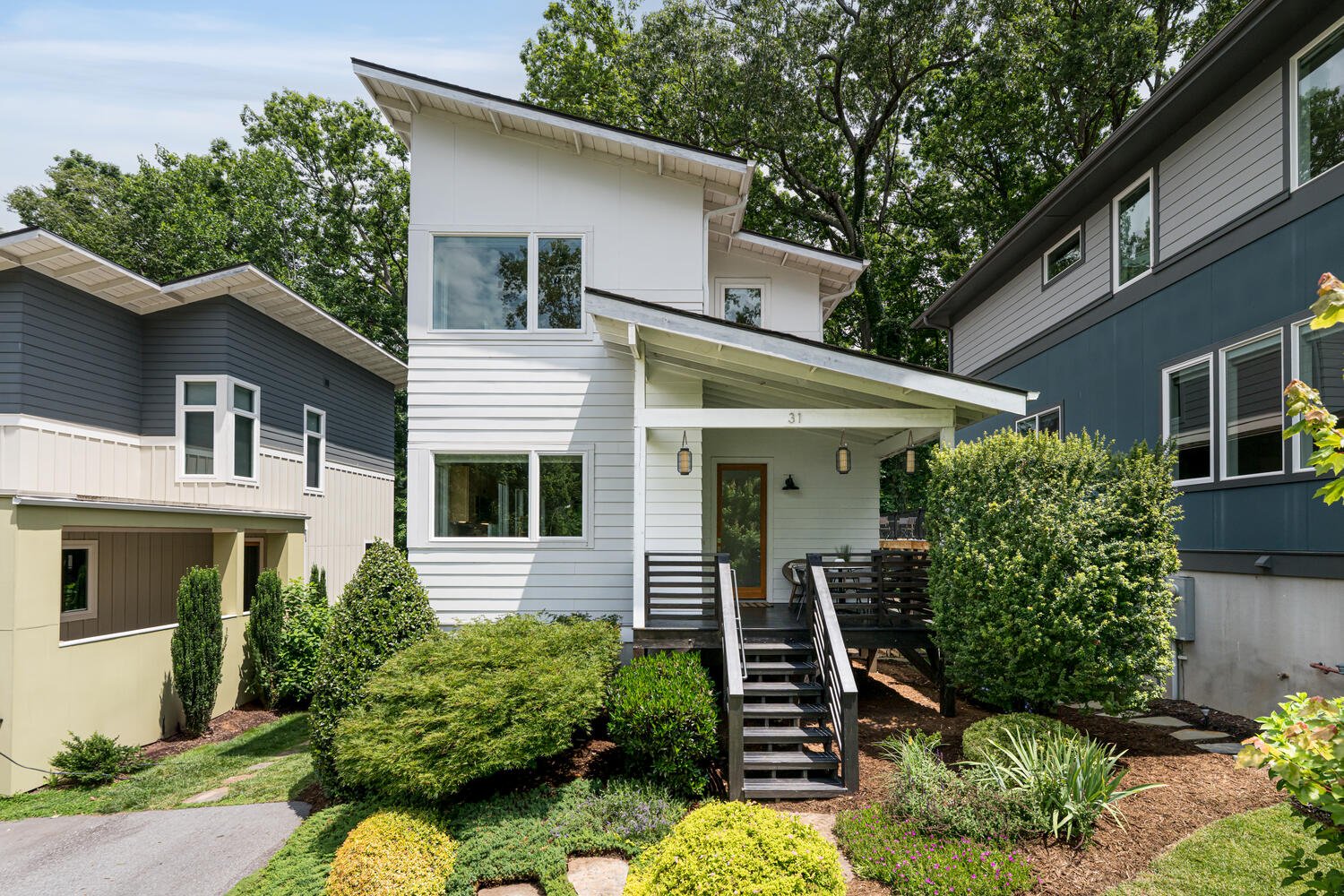
This stepped, vertical plan became Asheville’s new vernacular — a design language that embraces the hillside rather than fighting it. You can find these homes scattered throughout the city — from West Asheville’s winding side streets to the aptly named Chicken Hill, where Sun Builders and others helped shape the shed-roof form into something quietly elegant.
From “Chicken Shack Chic” to The Modern Shed
When I first started noticing these homes emerging on the slopes around town, I jokingly called the style “Chicken Shack Chic.” It was a playful nod to the slanted-roof sheds and chicken coops that have dotted rural lots across Western North Carolina for generations — humble, functional, and a little quirky.
But as the architecture itself evolved — as local designers refined the form with glass, steel, and cedar — the nickname began to feel too casual for what was taking shape. The homes had matured, and so had the language around them.
By the early 2010s, builders like Adam Pittman were among the first to bring the Modern Shed to scale. His work across West Asheville and Riverview used steep, leftover lots that many others avoided — transforming unofficial dumping grounds into tight-knit neighborhoods of vertical living. Homes like the Anderson House, built in 2013, rose three stories above the slope: 1,560 square feet on just 0.16 acres, a “tower home” of glass and wood that captured both view and light.
Some residents initially resisted these changes — calling them “birdhouses” or lamenting the loss of green space — yet others saw renewal. As Pittman put it, “All these lots were left over because nobody wanted to build on them. Now people building on the undesirable lots are creating the face of our new neighborhoods.”
What began as a playful experiment in slope-living had, by the mid-2010s, become Asheville’s architectural calling card.
As the Wilsons of W2 Architects explain:
“For us, the modern shed form began on wide mountain lots for owners seeking a home that was clean and low-profile while maximizing views. The shed roof was often a compromise for people who wanted the look of a modern flat-roof house but wanted to avoid the upkeep headaches and cost of a membrane roof.
This aesthetic was then adapted for people with city lots and varying budgets. Owners of infill lots weren’t ‘giving up’ on the modern flat roof — they were requesting the modern shed specifically. In many cases, it was at least partially rooted in a rejection of the traditional housing form, particularly the gable. People who moved to and embraced Asheville’s ‘weirdness’ wanted a house that, in their mind, projected that attitude. As lots became narrower, the form grew taller — but it maintained the bold, simple roofline.”
Their observation captures an important shift: what began as pragmatism became intention. The Modern Shed wasn’t just responding to slope, budget, or zoning — it was expressing identity.
Honest Materials, Simple Lines
These homes are defined by restraint and structural honesty. Rooflines are singular, not tangled. Siding mixes metal, cedar, and cement board, revealing layers rather than concealing them. Interiors lean toward light oak, concrete, plywood, and white walls — materials that age well and require little fuss.
The focus is on proportion, light, and texture, not embellishment. It’s a quiet modernism — one shaped by budget, terrain, and a desire for realness over show.
Modern Meets Modest
The soul of the Modern Shed lies in its modesty. These homes aren’t built for grandeur but for right-sized living — compact footprints, open layouts, and adaptable spaces that flex between work, rest, and play. Many use passive solar design, rainwater systems, and edible landscapes — not as eco-luxury statements, but as common-sense mountain living.
It’s architecture for people who care less about impressing and more about belonging.
A Culture of Makers
Part of what makes Asheville’s design culture unique is its hands-on spirit. Much like the craftspeople of the Arts and Crafts era, today’s architects and builders — from W2 Architects to JAG Builders, Lobo Builders, and Sun Construction — blur the line between design and making. Homeowners often join in the process, salvaging materials, helping with siding, or hand-finishing cabinets.
These homes aren’t just lived in; they’re crafted.
In neighborhoods like Craggy Park, this sensibility has matured. Designed by my friends at W2 Architects, the community refines and elevates the Modern Shed ethos — simple rooflines, sustainable design, and a walkable, community-oriented layout. It’s the mountain vernacular, reimagined for a new century.
A New Vernacular for the Mountains
If the Craftsman bungalow once defined Asheville’s early neighborhoods, the Modern Shed has become its contemporary counterpart. It expresses the same underlying values:
Work with the land, not against it.
Keep design honest and adaptable.
Build for longevity, not for trend.
Seen together, these homes mark a subtle but profound evolution — a city moving from preserving beauty to creating it anew, grounded in the same spirit of craftsmanship that started here over a century ago.
The Spirit of the Modern Shed
What began as a joke about chicken shacks has become a true architectural language of place. It’s mountain modernism with humility — design that climbs with the slope, catches the light, and leaves room for life. These homes don’t posture — they participate.
They leave space for art, pets, gardens, friends, and sometimes actual chickens.
They celebrate imperfection, experiment, and ease.
In a city that thrives on creativity, the Modern Shed feels inevitable — the next honest step in Asheville’s evolving story. Whether you call it the Modern Shed, the Urban Roost, or the Three-Level Nest, it’s all part of the same conversation: architecture that belongs to both the mountain and the moment.