The Modern Shed
Author’s Note
I started trying to define the modern shed in words last summer. I could see the pattern clearly in Asheville—narrow, simple forms responding to steep lots, tight budgets, and a desire for something contemporary that still felt grounded—but I didn’t yet have the language for it.
This essay brings those observations together. It’s not meant to label a trend or set rules, but to name a recurring approach to building that has emerged quietly over time—practical, adaptive, and shaped by place. If this piece does anything, I hope it helps make visible something many of us have already been living with for years.
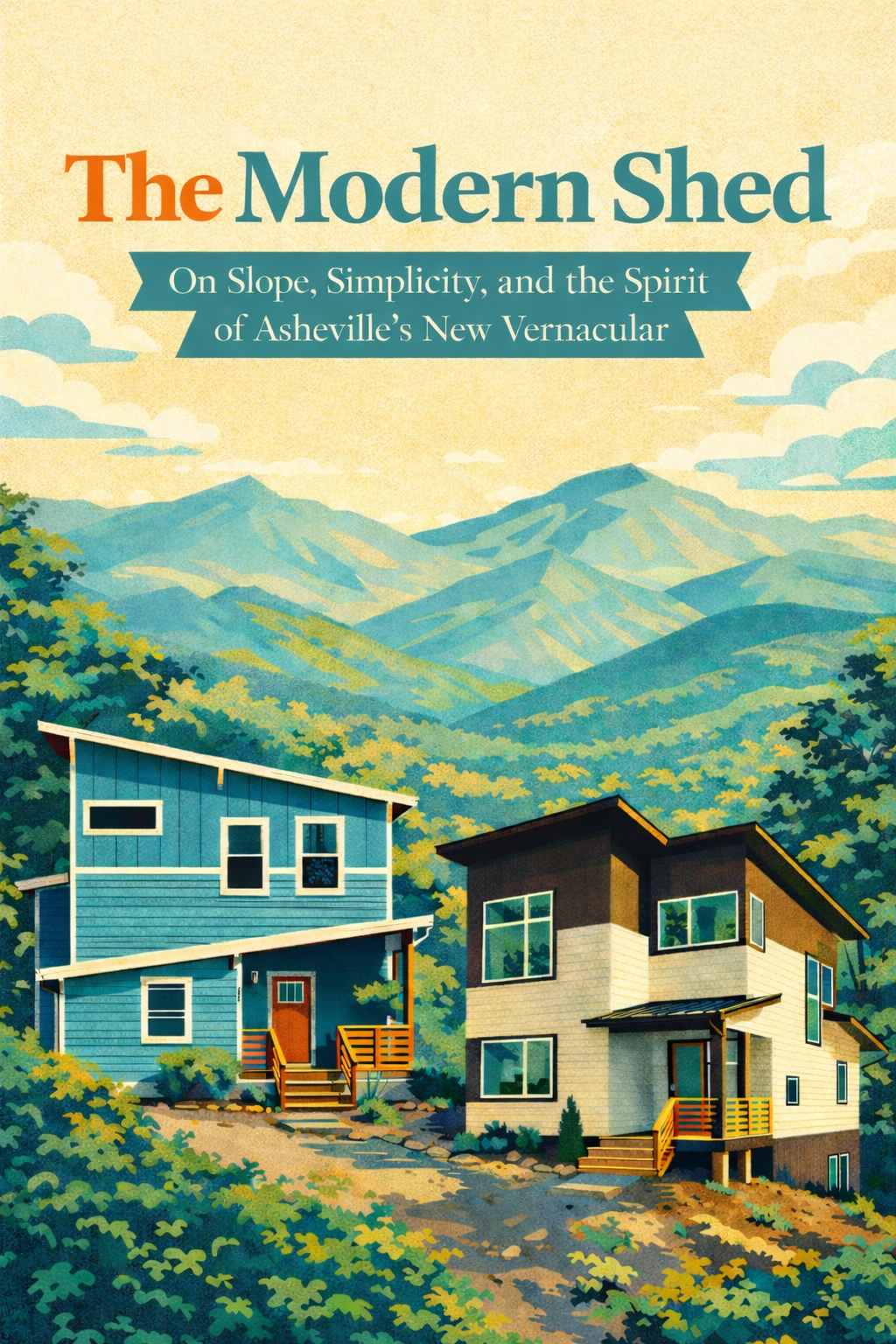
On Slope, Simplicity, and the Spirit of Asheville’s New Vernacular
When I moved to Asheville in 2006, the architectural conversation felt rooted almost entirely in the past. The homes most admired were the Arts and Crafts bungalows of Montford and Grove Park, the Art Deco landmarks downtown, and the lovingly preserved Victorian cottages scattered through older neighborhoods. Asheville had — and still has — a deep affection for its historic character, and preservation rightly shaped much of the city’s identity.
What felt less visible at the time was the present — and the quiet work of adaptation happening alongside that preservation. Modernism existed here too, but often hiding in plain sight: tucked into hillsides, woven into mid-century neighborhoods like Lakeview Park and Town Mountain, or quietly inserted along steep side streets in West Asheville. Few talked about these homes, and fewer still celebrated them.
That gap — between what Asheville preserved and what it was becoming — is what first drew me to write about and photograph modern architecture here. I wasn’t interested in replacing the past, but in making space for another thread in the city’s story: one shaped by light, landscape, and the realities of contemporary mountain living.
Necessity Before Style
Long before “mountain modern style” became a marketing term, Western North Carolina already had a pragmatic building language. Old sheds, barns, apple houses, and outbuildings across the region shared a common logic: simple construction, honest materials, and deep respect for slope, drainage, and weather. These structures weren’t designed to impress. They were designed to work.
Embedded into hillsides and shaped by necessity, they became the quiet ancestors of what would later emerge as Asheville’s newest vernacular.
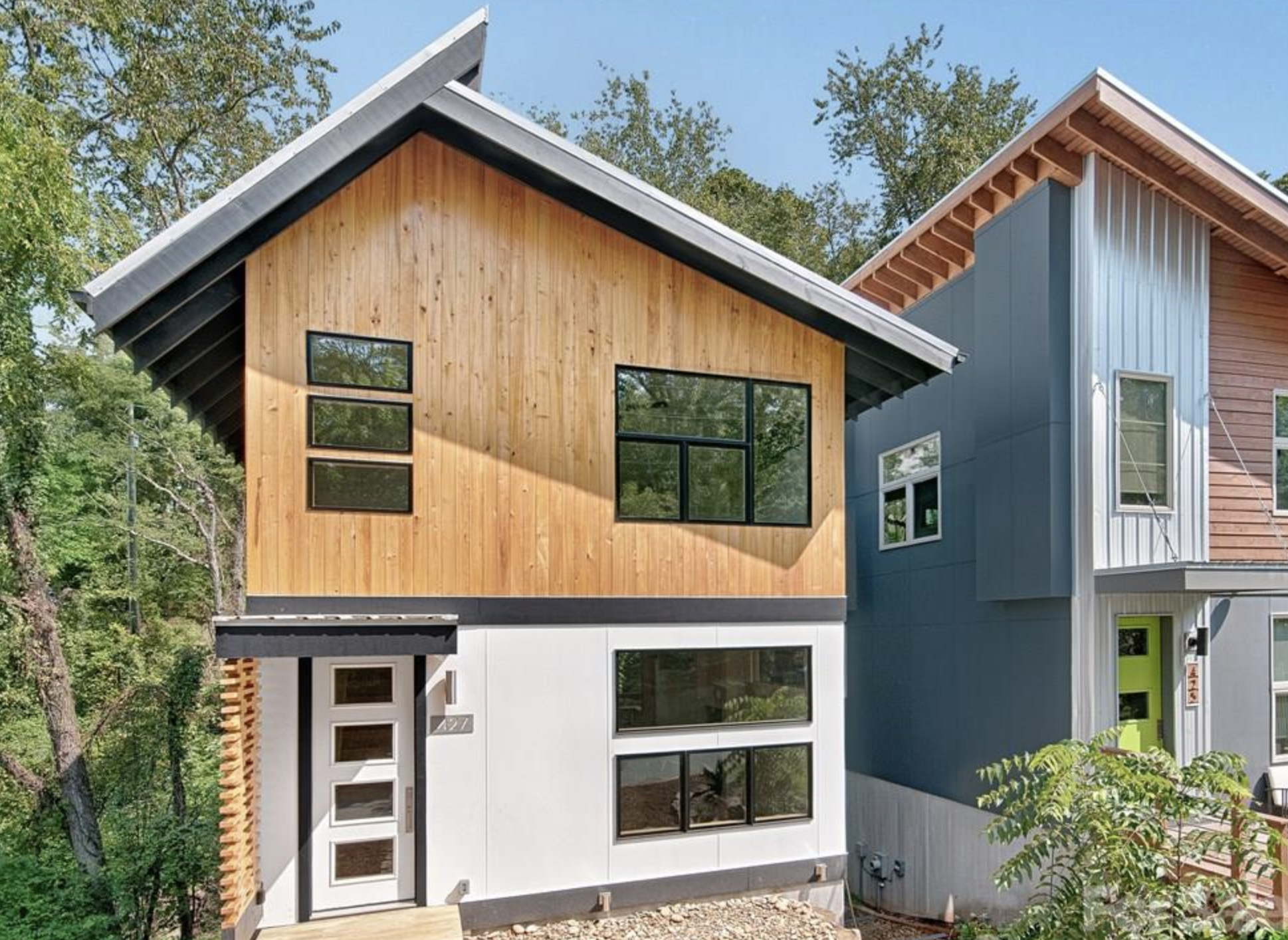
Sun Construction in Chicken Hill
Building With the Slope
By the late 2000s and early 2010s, Asheville was changing rapidly. Infill lots were increasingly scarce, and much of what remained was steep, narrow, or irregular — especially in places like West Asheville, Chicken Hill with Sun Construction, and along the edges of Riverview. Builders faced a choice: force conventional homes onto difficult sites, or adapt.
Many chose adaptation.
Out of this necessity emerged a vertical form that climbed with the hillside rather than resisting it. A typical Modern Shed unfolds in three tiers: a grounded lower level tied to the slope; a middle living level open to light, decks, and views; and private spaces above — all wrapped beneath a single shed roof angled to shed rain and capture daylight.
This wasn’t a stylistic move. It was a geographic one.
From Chicken Shack Chic to Intention
When I first noticed these homes appearing on Asheville’s slopes, I jokingly called the style “Chicken Shack Chic” — a nod to the slanted sheds and chicken coops long scattered across rural lots. But as the architecture matured, so did the language around it.
Architects like W2 Architects helped refine the form in neighborhoods like Craggy Park — especially on tight city lots — balancing clean modern lines with realistic budgets, drainage, and durability. What began as a practical alternative to flat roofs became a deliberate aesthetic choice. Homeowners weren’t giving something up; they were choosing a form that felt aligned with Asheville’s terrain and cultural independence.
Architect Aaron Wilson says,”As this aesthetic moved into city lots and varied budgets, the “modern shed” became a choice, not a compromise. Infill owners were drawn to its clear rejection of traditional gabled forms and its alignment with Asheville’s cultivated weirdness. The houses grew narrower and taller, but the roofline stayed bold and simple.”
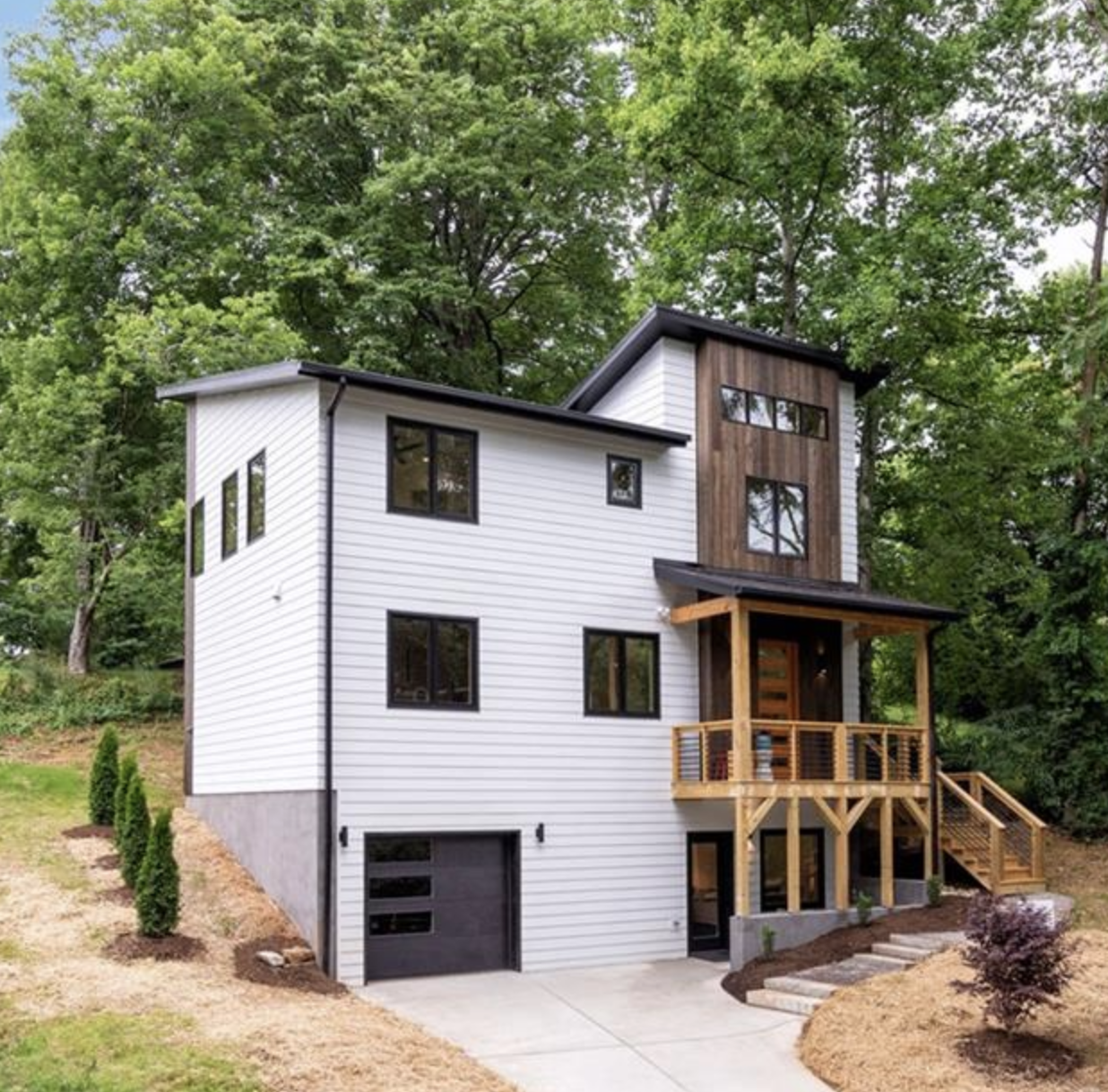
West Asheville home designed and built by Adam Pittman
From Experiment to Vernacular
By the early 2010s, builders like Adam Pittman began applying the Modern Shed at scale, particularly across West Asheville and Riverview. Steep, previously avoided parcels — former dumping grounds or leftover lots — were transformed into compact, vertical homes that captured light and view while using minimal footprint.
Not everyone welcomed the change. Some dismissed the homes as “birdhouses.” Others saw renewal. What had once been an experiment in slope-living became one of Asheville’s most recognizable architectural signatures.
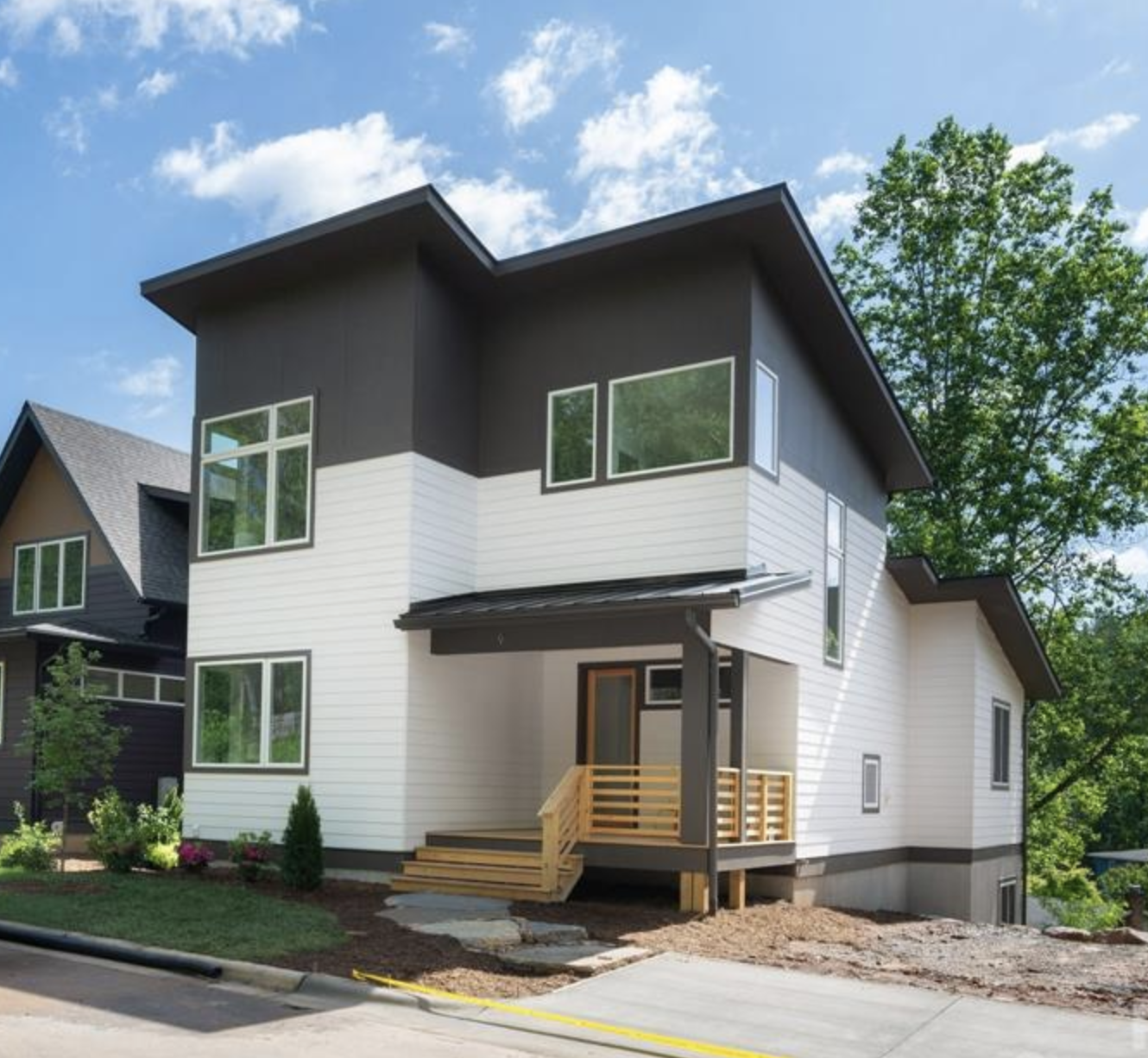
Craggy Park designed by W2 Architects
Quiet Modernism, Lived-In
The Modern Shed is defined by restraint. Singular rooflines. Honest materials. A mix of metal, cedar, and cement board outside; light wood, concrete, and white walls inside. The emphasis is on proportion, texture, and daylight — not embellishment.
These homes are modest by design. Compact footprints, flexible interiors, and vertical organization reflect a way of living that values belonging over display.
In places like Craggy Park, the ethos has matured further — pairing simple shed forms with walkability, sustainability, and human-scaled planning. It’s the mountain vernacular, quietly refined into warm, functional family homes.
Living With Choice
Over the years, what has stayed with me most isn’t just the architecture, but the people drawn to it. The Modern Shed tends to attract those in moments of recalibration — artists simplifying, families tightening their footprint, individuals choosing light and view over square footage. These homes aren’t usually chosen casually. They’re arrived at slowly, after questions about how much space is enough, what kind of quiet matters, and how close one wants to be to land, weather, and community.
Watching these decisions unfold has shaped how I understand housing here — not as a product, but as a response. A response to terrain, yes, but also to changing lives.
A Living Vernacular
If the Craftsman bungalow once defined Asheville’s early neighborhoods, the Modern Shed has become its contemporary counterpart. Both share the same underlying values: work with the land, build honestly, and let form follow life.
What began as a joke about chicken shacks has become a true architectural language of place — mountain modernism with humility. Design that climbs with the slope, catches the light, and leaves room to live.
Less a trend than an inevitability.
Architecture shaped by both the mountain and the moment.